Iwamura Electric
Memoirs of a GeishaIwamura Electric is an Osaka manufacturer whose history runs alongside Sayuri’s rise in Gion and the upheavals of war and occupation. Founded by the future Chairman and sustained by his partnership with Nobu Toshikazu, it gives the two men influence well beyond the company itself: its patronage draws Sayuri into their circle, and its threatened postwar survival becomes a test of their business partnership and her relationships with both men.
Origins and Growth
The Chairman’s route into the electrical industry began at seventeen, when he went to work for a small company in Osaka and soon supervised crews wiring factory machinery. As household and office demand for electric lighting grew, he designed a fixture that would let two bulbs work from a socket intended for one. The company’s director declined to manufacture it. At twenty-two, in 1912, shortly after marrying, he left to establish Iwamura Electric and build the rejected idea into the new company’s first product: a ceramic two-bulb socket.
The early years were difficult, but the company won an electrical-wiring contract for a new building on an Osaka military base in 1914. Nobu, still in the military and finding civilian work difficult because of his war wounds, was assigned to oversee the work. He and the Chairman became friends; when the Chairman offered him a job the following year, Nobu accepted. Their partnership divided responsibility between the men: the Chairman directed the company’s growth, while Nobu managed it. The Chairman later credited Nobu with saving the company from ruin in the early 1920s by bringing in investors, and publicly said that Iwamura Electric would not have survived several crises without him.
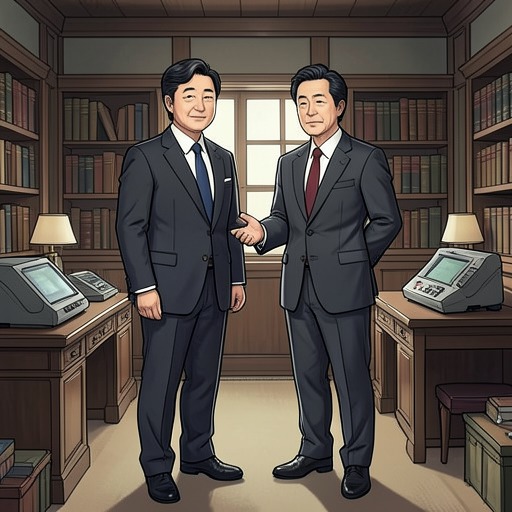
The two men’s public image captured their different roles. A widely used photograph showed the Chairman in a three-piece wool suit holding the company’s ceramic socket, while Nobu stood beside him in a morning coat and pin-striped trousers. The contrast between the company’s inventor and its manager accompanied a partnership that, despite Iwamura Electric’s smaller size, made them better known than leaders of much larger firms. Articles Sayuri found described the company as more innovative and better regarded than its chief rival in western Japan, Osaka Electric.
Patronage and Public Standing
Iwamura Electric’s corporate success also carried the Chairman and Nobu into Gion’s social world. When Mameha took Sayuri to a sumo exhibition, she explained that they would attend as guests of the company’s founder, the Chairman, and that Nobu, its president, had helped organize the event because he was a sumo fan. The Chairman’s presence had a practical business purpose: Nobu explained that he had agreed to sponsor the exhibition, although sumo itself did not interest him. The occasion thus presents the company not only as a manufacturer but as an institution able to turn business standing into public and social connections.
Those connections later shaped Sayuri’s own place in the company’s orbit. After weeks without news from the men, a secretary from Iwamura Electric requested her company for an evening at the Ichiriki Teahouse. Sayuri hoped the invitation had come from the Chairman, while Mameha hoped it was from Nobu. When Sayuri was adopted into the Nitta household, she no longer felt obliged to treat Nobu as her indispensable savior; at a later company gathering, she took the vacant place beside the Chairman. He was cordial but did not look at her. Nobu, by contrast, watched her intently, and Sayuri made a point of spending time with him rather than ignoring him.
The company’s business gatherings could also become occasions of personal uncertainty. Nobu sent Sayuri a fine wooden travel trunk after hearing she would appear in a festival in Hiroshima. She planned to thank him at an Iwamura Electric party, but shortly before it, she was told her company would not be needed. At the Ichiriki that night, she heard the Chairman’s laughter from a banquet room after another geisha emerged. The unexplained exclusion made the company’s invitations more than routine engagements: access to its parties determined whether Sayuri could see the men whose attention she valued.
War and Material Crisis
During the war, Iwamura Electric’s position became precarious as the government pressed it to change its production. Nobu told Sayuri that the company had resisted orders to manufacture military goods and that, by the time the Chairman agreed to cooperate, the war was nearly over; nothing the company made for the government had been used in battle. Yet the wartime authorities wanted the appliance manufacturer to design and build fighter airplanes. Nobu described the demand as a threat to the company’s existence and said the Chairman might lose his job or face prison if he did not comply.
The war also destroyed much of the company’s physical base. After two of its four Osaka factories were demolished, Nobu gave Sayuri a piece of concrete from the rubble. He framed it as a piece of himself, answering the meaning she had attached to a fan she had given him, and asked her to turn the fragment into a jewel she could keep. The damaged concrete makes the company’s crisis tangible: Iwamura Electric was not merely facing uncertain finances but trying to survive with half its factories gone.
The danger intensified after the war under the Allied Occupation. Nobu said the authorities had classified Iwamura Electric as a zaibatsu, despite its much smaller scale compared with Mitsubishi, and might seize its assets to pay reparations. The company’s refusal to produce war materiel had not protected it from being grouped with large industrial concerns. Nobu also resented the appointment of Deputy Minister Sato to recommend what should happen to the case, and warned that the Chairman and he might never again be allowed to work in business if the company were seized.
Rescue, Patronage, and Aftermath
The company’s case became entangled with Sayuri’s patronage. Nobu later told her that he and Sato had asked the proprietress of the Ichiriki about the possibility of Sato becoming her danna. Nobu explained that Sato had helped Iwamura Electric by persuading the Occupation authorities to reopen its case after they had been prepared to make a final judgment against the company. Nobu’s proposal was therefore not simply a personal arrangement: it was tied to the intervention on which the company’s future depended.
The threatened seizure was averted. At the end of June, Sayuri read a newspaper report stating that Iwamura Electric had secured financing from Mitsubishi Bank. The article reported that the Occupation authorities had changed the company’s classification, lifting restrictions on entering contracts and applying for loans, and that it had secured a large loan the previous day. Mother recognized at once that the company’s fortunes had turned around; Sayuri, confronted with the article’s business terms and figures, said she barely understood what she had read. The shift from threatened confiscation to restored access to contracts and credit marks a decisive reversal in Iwamura Electric’s postwar fortunes.
Across the narrative, Iwamura Electric links industrial history to intimate relationships without making them identical. Its growth rests on the Chairman’s invention and Nobu’s management; its social prominence brings Sayuri into their company; its wartime destruction and postwar classification put the men’s livelihood at risk; and its eventual financing alters the stakes of Nobu’s proposed patronage arrangement. The concrete fragment from the Osaka factory and the dense newspaper account of loans and restrictions give material form to a crisis that reaches from ruined buildings and threatened assets into the personal attachments surrounding the company.